- Smart Home Energy Saving in 2026: How to Cut Electricity Bills Without Losing Comfort
- Why energy saving has become a 2026 household priority
- The real foundation of smart energy saving
- Heat pumps are becoming the central efficiency technology
- Smart thermostats are useful, but not universal
- The 2026 shift from isolated devices to home energy management
- Why cooling is becoming a major energy-saving issue
- Appliance standards and labels are becoming more important
- Hot water deserves more attention than it gets
- The smartest savings still come from boring maintenance
- How to choose the first upgrade
- Expert assessment of the 2026 energy-saving market
- Final takeaway
Smart Home Energy Saving in 2026: How to Cut Electricity Bills Without Losing Comfort
Energy saving is no longer only about switching off lights. It has become a practical way to control household bills, choose smarter appliances, and prepare for a more electric future. For more useful energy guides and practical explanations, visit https://infok.com.ua/blog/energetyka/ where readers can find accessible articles on everyday energy topics.
The strongest traffic angle inside the broad topic of energy saving is not abstract “energy efficiency”, but smart home energy saving. People search for direct answers: how to reduce electricity bills, which appliances consume the most, whether smart thermostats are worth it, how efficient heat pumps are, and what to buy first. This topic also connects well with current energy news, because electricity demand is rising, cooling is becoming more important, and governments are updating efficiency rules for appliances and heating equipment. The IEA reports that global electricity demand grew by around 3% in 2025, while electricity demand grew about 2.3 times faster than total energy demand. Household appliances, commercial buildings, industry, electric vehicles and data centers all contributed to this shift.
Why energy saving has become a 2026 household priority
The old view of energy saving was based on restriction: use less light, heat less, cool less, and accept discomfort. That approach still appears in many articles, but it is not the most useful way to think about household efficiency in 2026. The modern approach is different. It starts with the idea that a home should provide the same or better comfort with less wasted energy.
This matters because the energy system is entering a more electricity-heavy period. The IEA’s Global Energy Review 2026 says global energy demand growth slowed to 1.3% in 2025, but electricity demand grew much faster and remained above the average of the previous decade. In other words, electricity is becoming the central form of household energy, and the home is becoming a more important part of the wider energy system.
For homeowners and renters, this creates a practical question: where should money and attention go first? A smart plug is cheap, but it will not fix a poorly insulated house. A heat pump can be very efficient, but only if the building, controls and electricity tariff make sense. Solar panels may reduce grid purchases, but without load management or storage, some of the benefit can be lost.
The best energy-saving strategy is not the most expensive one. It is the one that removes the largest amount of waste from the specific home, at the right moment, with the shortest realistic payback.
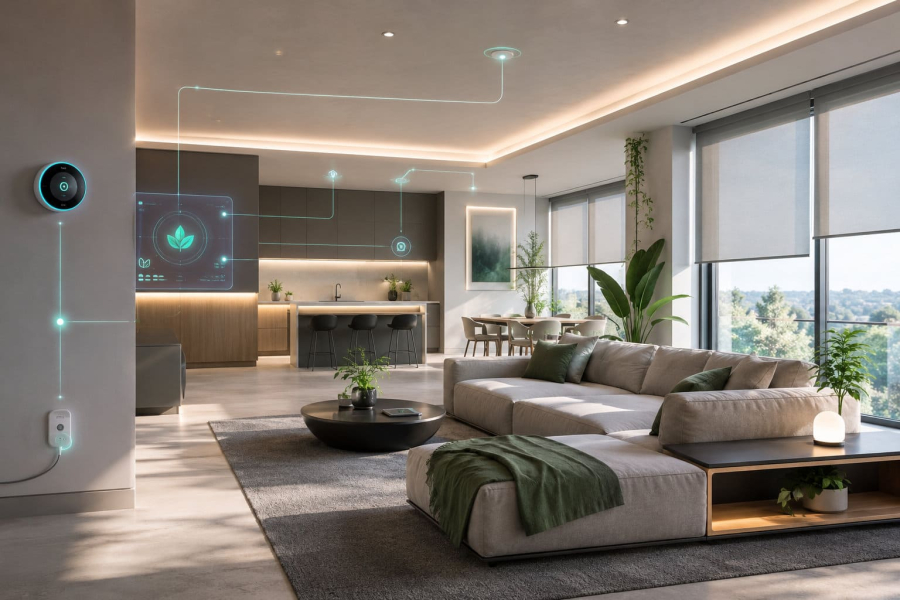
That is why this article focuses on smart energy saving, not just smart devices. A smart home should not be understood as a collection of gadgets. It should be understood as a system where heating, cooling, hot water, appliances, ventilation, tariffs and user habits work together.
The real foundation of smart energy saving
Before buying new equipment, the first step is to understand where energy is actually going. In many homes, the largest energy loads are heating, cooling and hot water. The U.S. Department of Energy notes that heating equipment is typically the largest energy user in a home, making up about 30% of the utility bill, while water heating accounts for nearly 20% of average home energy use.
This means that a home can install efficient bulbs, smart plugs and new chargers, but still waste the biggest savings through poor heating control, an old water heater, air leaks, bad insulation or inefficient cooling. Small devices matter, but the thermal systems usually decide the real bill.
The practical hierarchy should look like this:
-
Measure electricity and heat use before making upgrades;
-
Reduce avoidable losses through insulation, sealing and maintenance;
-
Improve heating, cooling and hot water systems;
-
Replace inefficient appliances when they reach the end of useful life;
-
Add automation, smart controls, solar or storage where they support the main system.
This order is important because it prevents a common mistake. Many households buy visible devices first, then later discover that the real problem was hidden: leaking ducts, poor thermostat settings, an oversized boiler, a freezer in a hot room, or a water heater that works too often. Energy saving becomes much cheaper when diagnosis comes before shopping.
Heat pumps are becoming the central efficiency technology
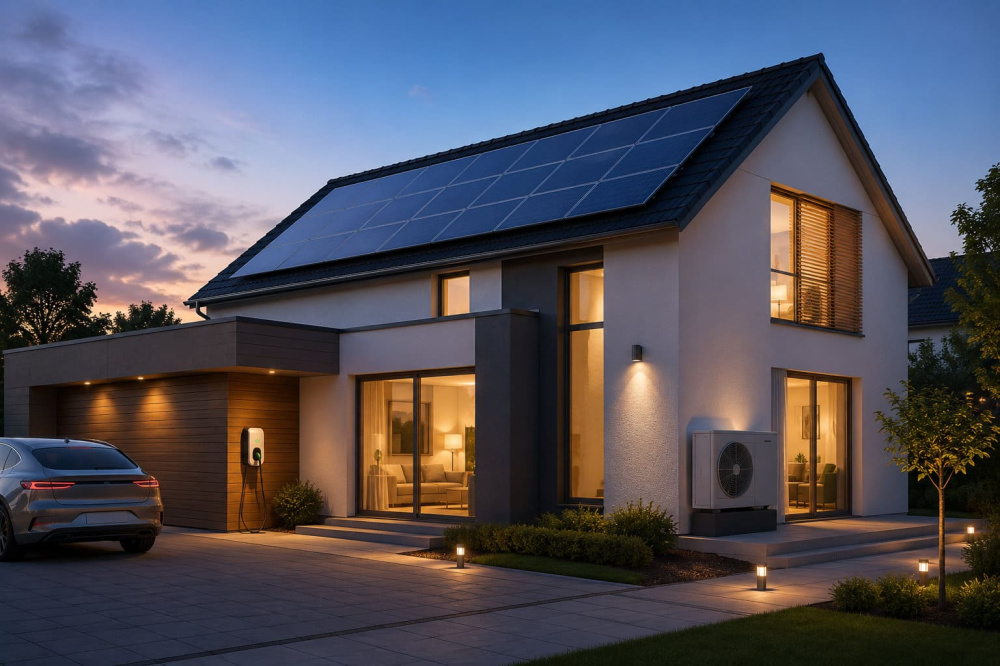
Heat pumps are one of the most important energy-saving technologies for homes because they move heat instead of generating it directly. The European Commission describes heat pumps as mature technology that can be around 3 to 5 times more energy efficient than gas boilers, because they use ambient energy from air, ground, water or waste heat.
This does not mean every home should install a heat pump tomorrow. The real result depends on climate, building insulation, radiator or floor heating design, electricity prices, gas prices, installation quality and maintenance. In a well-prepared building, a heat pump can be a major efficiency upgrade. In a leaky building with poor controls, it may still save energy, but the comfort and cost results can disappoint.
The latest market signals are mixed, which makes the topic especially relevant in 2026. IEA data shows global heat pump sales fell by about 2% in 2025. At the same time, Europe returned to growth with an 11% annual increase, Germany saw a strong first half, and heat pumps outsold gas boilers in Germany for the first time. In the United States, heat pump sales fell by around 13% in 2025, although they still outsold gas boilers for the fourth year in a row.
Heat pumps are not a magic box. They are a high-efficiency platform, and their real value appears when the building envelope, water temperature, controls and tariff are aligned.
From an expert point of view, the biggest opportunity is not only replacing gas or electric resistance heating. It is combining a heat pump with weather compensation, smart scheduling, room-by-room control, better insulation and, where possible, cheaper off-peak electricity. That is where the next stage of household energy saving is moving.
Smart thermostats are useful, but not universal
Smart thermostats are one of the most accessible energy-saving upgrades because they improve control rather than replacing the entire heating or cooling system. ENERGY STAR defines a smart thermostat as a Wi-Fi enabled device that automatically adjusts heating and cooling settings for better performance. Certified models are independently verified using field data, not only laboratory assumptions.
The realistic savings are moderate but meaningful. ENERGY STAR says the average certified smart thermostat saves approximately 8% of heating and cooling bills, or about $50 per year, with actual savings depending on climate, comfort preferences, occupancy and HVAC equipment.
This is why smart thermostats should be promoted honestly. They are excellent for homes with irregular schedules, forgotten temperature settings, strong cooling demand, or heating systems that are often left running unnecessarily. They are less impressive in homes where occupants already manage temperature carefully or where the HVAC system is inefficient for mechanical reasons.
A good smart thermostat should not just turn the system on and off remotely. It should help the household understand runtime, temperature patterns, occupancy and equipment behavior. In a modern home, the thermostat becomes the first layer of energy intelligence.
The 2026 shift from isolated devices to home energy management
The most interesting innovation in household energy saving is not one device. It is the move toward home energy management systems. These systems coordinate several loads at once: heat pumps, water heaters, batteries, solar panels, EV chargers, appliances and sometimes dynamic electricity tariffs.
The European Commission’s 2026 digital energy measures show why this trend matters. It states that digitalisation can improve efficiency, help users respond to price signals, reduce costs and improve visibility across the grid. The Commission also estimates that AI-based operation and maintenance optimisation could save up to €94 billion annually by 2035.
Recent academic research points in the same direction. A 2026 systematic review in Frontiers found that AI, IoT sensors, machine learning and optimization methods can improve smart home energy management through real-time monitoring, adaptive scheduling and predictive analytics. The review also warns that practical deployment, cost, interoperability, security and privacy remain major barriers.
The newest energy-saving technologies are therefore less about “turning things off” and more about shifting, forecasting and coordinating consumption.
-
Smart thermostats reduce unnecessary heating and cooling runtime;
-
Heat pump water heaters cut hot water energy demand and can be scheduled for cheaper hours;
-
Home batteries store cheap grid electricity or solar generation for later use;
-
Smart EV chargers delay charging until lower-price or lower-carbon periods;
-
AI-based energy management systems learn patterns and coordinate several devices at once.
The practical benefit is simple. A dishwasher that starts at 2 a.m., a water heater that preheats during cheap hours, and an EV charger that avoids the evening peak can reduce costs without reducing comfort. The challenge is that all these devices must communicate reliably, and the user must remain in control.
Why cooling is becoming a major energy-saving issue
For many countries, energy saving used to mean winter heating. That is changing. Cooling is becoming a larger part of electricity demand, especially as heatwaves become more frequent and more households install air conditioning.
The IEA’s Electricity 2026 analysis forecasts that the buildings sector will contribute 49% of additional global electricity demand between 2025 and 2030. It also says higher electricity use from space cooling, data centers and heat pumps will make up almost half of the growth in the buildings sector worldwide.
This is why air conditioning efficiency is becoming a policy issue, not just a personal purchase decision. In June 2026, Reuters reported that the European Union proposed rules requiring installers of air conditioners, boilers and kitchen appliances to show customers energy performance labels when providing installation quotes. The goal is to help buyers compare efficiency before they make rushed decisions during heatwaves or equipment failures.
From a household perspective, this is crucial. A cheap inefficient air conditioner may look attractive during a hot week, but it can become expensive over several summers. The right decision should compare seasonal efficiency, room size, insulation, noise, maintenance, installation quality and control features.
Cooling is the next electricity bill shock for many homes. The homes that prepare with shading, insulation, efficient AC and smart controls will spend less while staying more comfortable.
Appliance standards and labels are becoming more important
Energy labels are sometimes treated as boring stickers, but they are becoming more important as homes add more electric equipment. The IEA notes that policy action accelerated in 2025, with over 250 new or updated efficiency policies in countries accounting for 85% of global energy demand.
The European Commission has also been updating rules for space and water heaters. In late 2025, it opened consultations on revised ecodesign and energy labelling rules for central space heaters and water heaters, including boilers and hydronic heat pumps. The revision aims to reflect technical and market progress, updated testing methods, sound power, NOx emissions and newer products such as hybrid heat pumps.
For consumers, this has a practical meaning. The energy label is not just an environmental symbol. It is a long-term bill indicator. A slightly more expensive efficient dryer, refrigerator, air conditioner or water heater can become cheaper over its lifetime than a low-efficiency model.
| Upgrade area | Main saving mechanism | When it usually makes sense | Main caution |
|---|---|---|---|
| Smart thermostat | Reduces unnecessary HVAC runtime | Homes with variable schedules or frequent overheating and overcooling | Savings are smaller if users already control temperature well |
| Heat pump for heating and cooling | Transfers heat instead of generating it directly | Homes with good insulation and suitable distribution systems | Poor installation can reduce comfort and efficiency |
| Heat pump water heater | Uses heat pump technology for hot water | Homes with high hot water use or expensive electric resistance heating | Needs proper sizing, airflow and installation conditions |
| Efficient air conditioner | Delivers more cooling per kWh | Hot climates, apartments, homes with rising summer bills | Oversizing can reduce comfort and efficiency |
| Home energy management system | Coordinates solar, battery, EV charging and flexible loads | Homes with dynamic tariffs, solar, batteries or EVs | Interoperability and privacy must be checked |
Hot water deserves more attention than it gets
Hot water is often ignored because the water heater is hidden in a utility room, basement, garage or technical cabinet. Yet it can be one of the largest energy users in the home. The U.S. Department of Energy identifies water heating as typically the second-largest home energy expense after heating and cooling.
A heat pump water heater can be especially valuable where a household currently uses electric resistance water heating. The DOE notes that efficient water heater upgrades can save hundreds of dollars every year, depending on the system and usage. It also lists heat pump water heaters among eligible upgrade categories in its home energy programs.
The expert rule is straightforward: if a water heater is old, poorly insulated, oversized, set too hot, or constantly reheating unused water, it is probably wasting money. Before replacement, a household should check water temperature settings, pipe insulation, shower flow, maintenance and usage habits. When replacement time comes, the lifetime operating cost matters more than the sticker price.
The smartest savings still come from boring maintenance
Energy-saving innovation is exciting, but basic maintenance still delivers some of the safest returns. Dirty filters, leaking ducts, clogged coils, poor airflow, bad seals, sediment in water heaters and incorrect settings can quietly destroy efficiency.
This is where many households make the wrong comparison. They compare new technology against old technology on paper, but they ignore real operating conditions. A high-efficiency air conditioner with blocked airflow can perform poorly. A smart thermostat connected to a badly maintained HVAC system can only optimize a weak system. A heat pump in a house with uncontrolled air leakage will work harder than necessary.
Smart energy saving therefore needs a simple discipline. Inspect the equipment that already exists. Clean or replace filters. Make sure vents are not blocked. Check refrigerator door seals. Defrost freezers when needed. Keep outdoor AC units clear. Maintain water heaters. These actions are not glamorous, but they preserve the efficiency that equipment was designed to deliver.
How to choose the first upgrade
The best upgrade depends on the home, but the decision can be structured. The goal is to avoid emotional purchases and focus on measurable impact.
-
Identify the largest load, usually heating, cooling, hot water or refrigeration;
-
Check whether the problem is behavior, maintenance, insulation or equipment age;
-
Estimate annual energy use, not only purchase price;
-
Compare rebates, tariffs, installation costs and expected lifetime;
-
Choose the upgrade that improves comfort and cuts the most waste per dollar.
This method is especially important for households with limited budgets. A small apartment may benefit most from an efficient inverter air conditioner and better shading. A detached house may benefit more from attic insulation, air sealing and heat pump planning. A home with solar panels may benefit from a battery or energy management system. A family with high hot water use may get more value from a heat pump water heater than from several smaller gadgets.
Expert assessment of the 2026 energy-saving market
The energy-saving market is moving in two directions at once. On one side, there are simple proven actions: insulation, efficient appliances, LED lighting, good maintenance, correct thermostat settings and water-saving habits. On the other side, there is a fast-growing smart layer: AI optimization, home energy management, connected thermostats, demand response, smart EV charging, batteries and tariff-aware automation.
The opportunity is real, but so is the risk of overbuying. Not every smart device pays for itself. Not every AI energy platform is mature. Not every advertised saving applies to every home. The best results come when technology solves a real problem that has already been measured.
The most promising direction is coordinated electrification. A home with a heat pump, heat pump water heater, efficient cooling, good insulation, solar generation, storage and smart control can reduce waste significantly. But the sequence matters. Electrification without efficiency can raise peak demand. Efficiency without smart control may miss cheaper electricity periods. Smart control without good hardware has limited effect.
In 2026, energy saving should be understood as a design problem. The question is not “Which device saves the most?” The better question is “Which combination of envelope, equipment, control and behavior gives this home the lowest energy waste with acceptable payback?”
Final takeaway
Smart home energy saving is one of the strongest practical energy topics because it connects household bills, comfort, technology and current policy trends. Electricity demand is rising, cooling is becoming more important, and heating systems are changing. At the same time, better labels, smarter controls, AI-based management and more efficient appliances are giving households new tools to manage consumption.
The winning strategy is not to chase every new device. It is to measure first, reduce waste, upgrade the biggest loads, and then use smart technology to coordinate the system. That is how energy saving becomes not a restriction, but a more intelligent way to live.
Smart home energy saving FAQ: practical answers for lower electricity bills
What is the best way to start saving energy at home in 2026?
The best way to start saving energy at home in 2026 is to identify where the most energy is being used. In many homes, the largest loads are heating, cooling, hot water, refrigeration and major appliances. Before buying smart devices, it is better to check insulation, air leaks, thermostat settings, appliance age and daily usage habits. This approach helps homeowners choose upgrades that reduce real waste instead of spending money on devices that may bring only small savings.
Do smart thermostats really reduce electricity bills?
Smart thermostats can reduce electricity bills when they are used with heating or cooling systems that run often. They help adjust temperatures automatically, reduce unnecessary runtime, and make it easier to avoid heating or cooling an empty home. The actual savings depend on climate, home size, insulation quality, comfort preferences and the type of HVAC system. A smart thermostat is usually most useful in homes where temperature settings are often forgotten or changed manually throughout the day.
Are heat pumps better than traditional heating systems for energy saving?
Heat pumps can be much more efficient than traditional electric resistance heaters or older fossil fuel systems because they move heat instead of creating it directly. This allows them to deliver more heat energy than the electricity they consume. However, the real result depends on proper installation, climate conditions, insulation, heating distribution and electricity prices. A heat pump works best when the home is prepared for efficient low-temperature heating and has good control settings.
Which home appliances use the most electricity?
The appliances and systems that usually use the most electricity are heating and cooling equipment, water heaters, refrigerators, freezers, dryers, ovens, dishwashers and air conditioners. The exact ranking depends on the home, climate and user habits. For example, air conditioning can dominate electricity bills in hot regions, while water heating can be one of the biggest loads in homes with high hot water use. Measuring actual consumption with a smart meter or plug-in energy monitor gives the clearest picture.
Is it worth replacing old appliances with energy-efficient models?
Replacing old appliances with energy-efficient models is worth considering when the appliance is near the end of its useful life, consumes a lot of energy, or runs continuously. Refrigerators, freezers, dryers, air conditioners and water heaters can have a noticeable impact on bills over many years. The purchase price should not be the only factor. A more efficient model may cost more at the beginning but become cheaper over its lifetime because it uses less electricity.
How can AI and smart home systems help with energy saving?
AI and smart home systems can help save energy by learning household routines, predicting demand and coordinating several devices at the same time. For example, a home energy management system can schedule water heating, EV charging, battery use and appliance operation during cheaper or more efficient periods. This is especially useful in homes with solar panels, dynamic electricity tariffs, batteries or electric vehicles. The main advantage is not only lower consumption, but better timing of consumption.
What is the difference between energy saving and energy efficiency?
Energy saving means reducing the amount of energy used, while energy efficiency means getting the same result with less energy. Turning off unused lights is energy saving. Replacing an old air conditioner with a more efficient model is energy efficiency. In a modern home, both approaches should work together. The best strategy is to avoid unnecessary use and choose systems that provide heating, cooling, lighting and hot water with less waste.
Can small daily habits really lower electricity bills?
Small daily habits can lower electricity bills, especially when they are repeated every day. Adjusting thermostat settings, washing clothes at lower temperatures, using appliances with full loads, turning off standby devices and reducing unnecessary hot water use can all help. However, habits alone may not solve high bills if the main problem is an old heating system, poor insulation or inefficient cooling. The best results usually come from combining better habits with technical upgrades.
What smart home energy upgrade should be done first?
The first smart home energy upgrade should match the biggest source of waste in the home. If heating and cooling are the main cost, a smart thermostat, better insulation or HVAC maintenance may be the right first step. If hot water is expensive, a heat pump water heater or better temperature control may be more effective. If the home already has solar panels or an electric vehicle, a home energy management system or smart charger may bring stronger benefits.
How can homeowners reduce cooling costs during hot weather?
Homeowners can reduce cooling costs by improving shading, closing curtains during peak sun, sealing air leaks, cleaning air conditioner filters and using efficient thermostat settings. An efficient inverter air conditioner can also reduce electricity use compared with older or poorly sized systems. Smart controls are useful because they prevent unnecessary cooling when nobody is home. The goal is to reduce heat entering the home first, then use cooling equipment as efficiently as possible.
Is solar power enough to make a home energy efficient?
Solar power can reduce electricity purchased from the grid, but it does not automatically make a home energy efficient. A poorly insulated home with inefficient appliances can still waste a lot of energy even if it has solar panels. Solar works best when combined with efficiency upgrades, smart load scheduling, batteries or tariff-aware energy management. The most effective approach is to reduce unnecessary consumption first, then cover the remaining demand with cleaner or cheaper electricity.
How often should a home energy-saving strategy be reviewed?
A home energy-saving strategy should be reviewed at least once a year and whenever there is a major change in the household. This includes installing new appliances, adding an electric vehicle, changing heating or cooling systems, renovating insulation, or seeing a sharp increase in electricity bills. Energy prices, technology and household habits change over time, so the best saving plan is not static. Regular review helps keep the home efficient and prevents hidden waste from growing.